Effets d’électrodynamique quantique en cavité avec des nanocristaux de pérovskite individuels couplés à une microcavité fibrée
Sorbonne Université · 2024
Research
I study how individual quantum emitters interact with light. During my PhD, I explored this interaction by coupling single perovskite quantum dots to an optical cavity. My current work brings spin control into the picture: I use optical spectroscopy and microwave manipulation to study individual defects in silicon carbide, while developing their optical and electrical environment.
01
Current research · Heriot-Watt University · Quantum Photonics Lab
A single defect in silicon carbide can host an electron spin that acts as a quantum bit. Light lets us prepare and read out the spin, while microwaves allow us to control it. Linking that spin to photons opens a route to connecting distant quantum devices. Nearby nuclear spins can also be controlled through the electron spin and used as quantum memories.
My current work focuses on combining improved photon collection with electrical control of individual defects in silicon carbide. Shaping the optical environment helps extract light that would otherwise remain trapped inside the material. At the same time, silicon carbide’s semiconductor properties allow us to use doping and device design to control the electrical environment around the emitter.
This electrical control can help stabilise the defect’s charge state, reduce spectral diffusion and tune its optical transition through the Stark effect. The aim is to bring these capabilities together in a device that provides a more efficient and stable optical interface to a single spin.
This work is part of the Integrated Quantum Networks (IQN) Hub’s Quantum Memory work package and the European QuSPARC project.


Studies on nuclear-spin memories and electrical control of single defects.
A. Bourassa et al. · Nature Materials 19, 1319–1325 (2020)
Control and entanglement of electron and nuclear spins in SiC, showing how individual nuclei can serve as quantum memories.
C. P. Anderson et al. · Science 366, 1225–1230 (2019)
Electrical control of single divacancies in SiC diodes, including charge-state control and reduced spectral diffusion.
Earlier work from the Quantum Photonics Lab and collaborators, published before I joined the group.
P. Cilibrizzi et al. · Nature Communications 14, 8448 (2023)
Isotopic enrichment greatly narrows the distribution of vanadium optical transitions at telecom wavelengths, helping bring different emitters into resonance.
A. R. Jones et al. · Nano Letters 25, 11528–11535 (2025)
Femtosecond laser writing places individual emitters close to the centres of pre-existing solid immersion lenses, improving photon collection.
C. Bekker et al. · Applied Physics Letters 122, 173507 (2023)
A scalable lithography and etching approach for making solid immersion lenses in SiC and enhancing light collection from individual emitters.
02
PhD research · Sorbonne Université · LPENS
During my PhD at Sorbonne Université, carried out at the Laboratoire de Physique de l’École Normale Supérieure (LPENS) in Paris, I studied the optical properties of individual colloidal perovskite nanocrystals. We first examined how quantum confinement shapes their emission spectra, providing a basis for understanding these quantum emitters before coupling them to a cavity.
We then coupled individual quantum dots to a tunable, fibre-based Fabry–Pérot microcavity at cryogenic temperature. Its open geometry allowed us to measure the same emitter in free space and in the cavity, providing a direct comparison of its emission in the two configurations.
By tuning the cavity into resonance with an individual quantum dot, we observed Purcell-enhanced emission with lifetimes below 100 ps. The quantum dot’s excitonic fine structure provided a way to extract the vacuum Rabi coupling strength from the spectral characteristics of the cavity emission, reaching ℏg ≈ 40 μeV.
Using a model of the emitter–cavity system to jointly analyse spectral characteristics and emission dynamics, we disentangled the contributions of pure dephasing and spectral diffusion to the measured emitter linewidth, without requiring interferometric measurements.
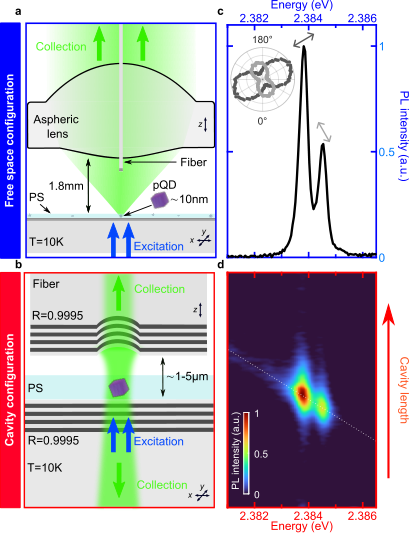
Cavity coupling and the optical properties of individual perovskite quantum dots.
Z. Said et al. · Nano Letters 26(14), 4815–4821 (2026)
Deterministic coupling of individual perovskite quantum dots to a tunable microcavity, with enhanced emission and a spectroscopic analysis of coupling, pure dephasing and spectral diffusion.
Open preprint · arXivM.-R. Amara, Z. Said et al. · Nano Letters 23(8), 3607–3613 (2023)
Cryogenic spectroscopy of individual CsPbBr₃ nanocrystals reveals how quantum confinement shapes exciton fine structure, trion and biexciton binding energies, and phonon replicas. The spectra and polarisation properties are interpreted through an exchange model and the orientation of the emitting dipoles.
Open preprint · arXivSorbonne Université · 2024
Related work from the Nano-Optique team and collaborators on cavity-coupled single-photon sources and perovskite exciton dynamics.
A. Jeantet et al. · Physical Review Letters 116, 247402 (2016)
A tunable fibre microcavity controls single-photon emission from an individual carbon nanotube through the Purcell effect.
A. Borel et al. · ACS Photonics 10, 2839–2845 (2023)
A colour centre grafted onto a carbon nanotube is coupled to a tunable fibre cavity to produce single photons at telecom wavelengths.
M.-R. Amara et al. · Nano Letters 24(14), 4265–4271 (2024)
Temperature-dependent spectroscopy reveals how phonon-assisted transfer between bright and dark exciton states shapes the emission dynamics and brightness of individual CsPbBr₃ nanocrystals.
Open preprint · arXiv